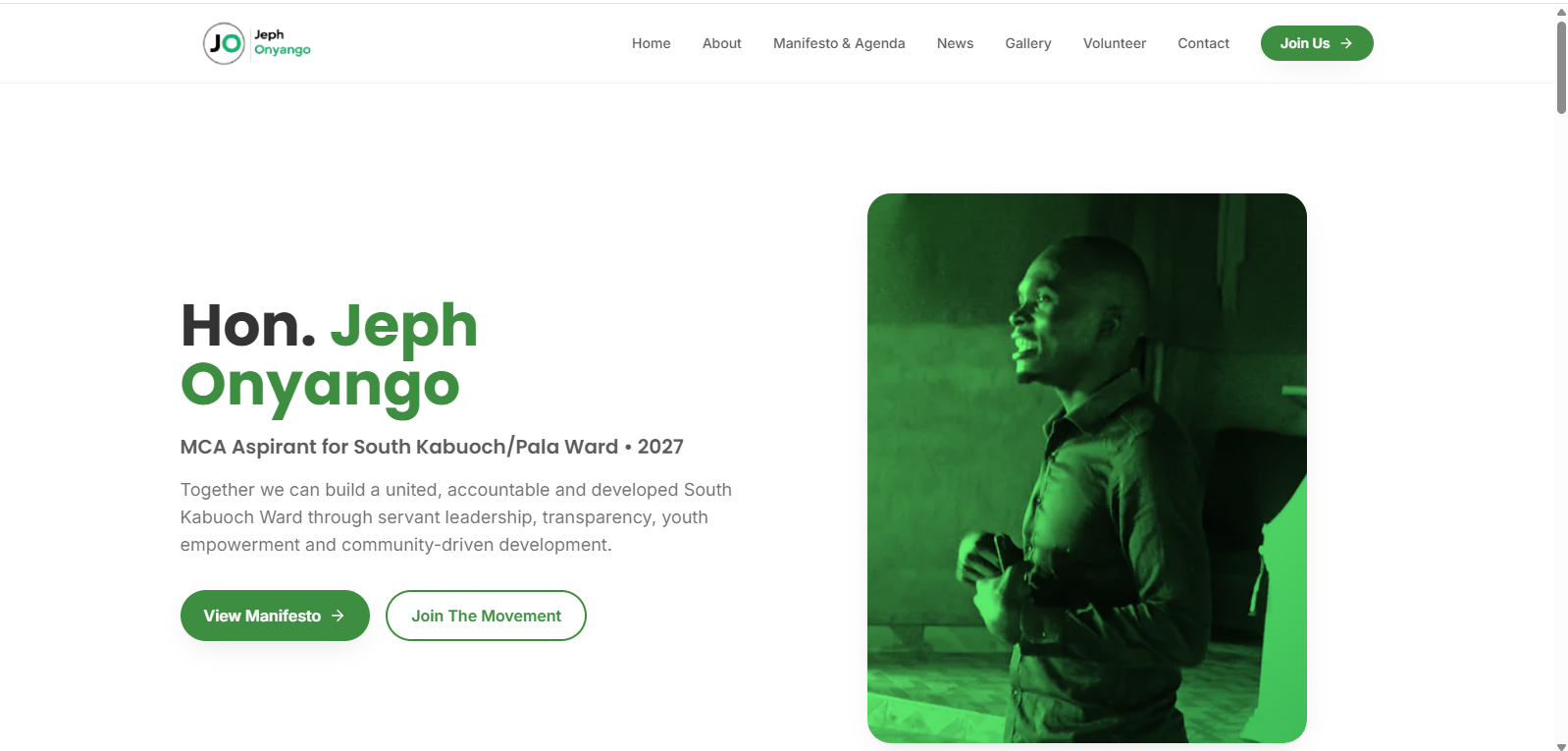
Designed and developed a modern, responsive political campaign website for Hon. Jeph Onyango to strengthen his online presence and effectively communicate his vision to constituents. The platform serves as a central hub for campaign information, featuring the candidate's profile, manifesto, latest news, events, media gallery, and contact channels.
The website was built with a strong focus on user experience, accessibility, and mobile responsiveness, ensuring seamless navigation across all devices. Performance optimization, clean UI design, and clear calls-to-action were prioritized to encourage voter engagement, volunteer sign-ups, and community interaction.
Key Features:
1. Responsive and mobile-first design
2. Candidate profile and campaign manifesto
3. News and campaign updates
4. Events and public engagement section
5. Media gallery for photos and videos
6. Contact and volunteer registration forms
7. Fast-loading pages with SEO-friendly structure
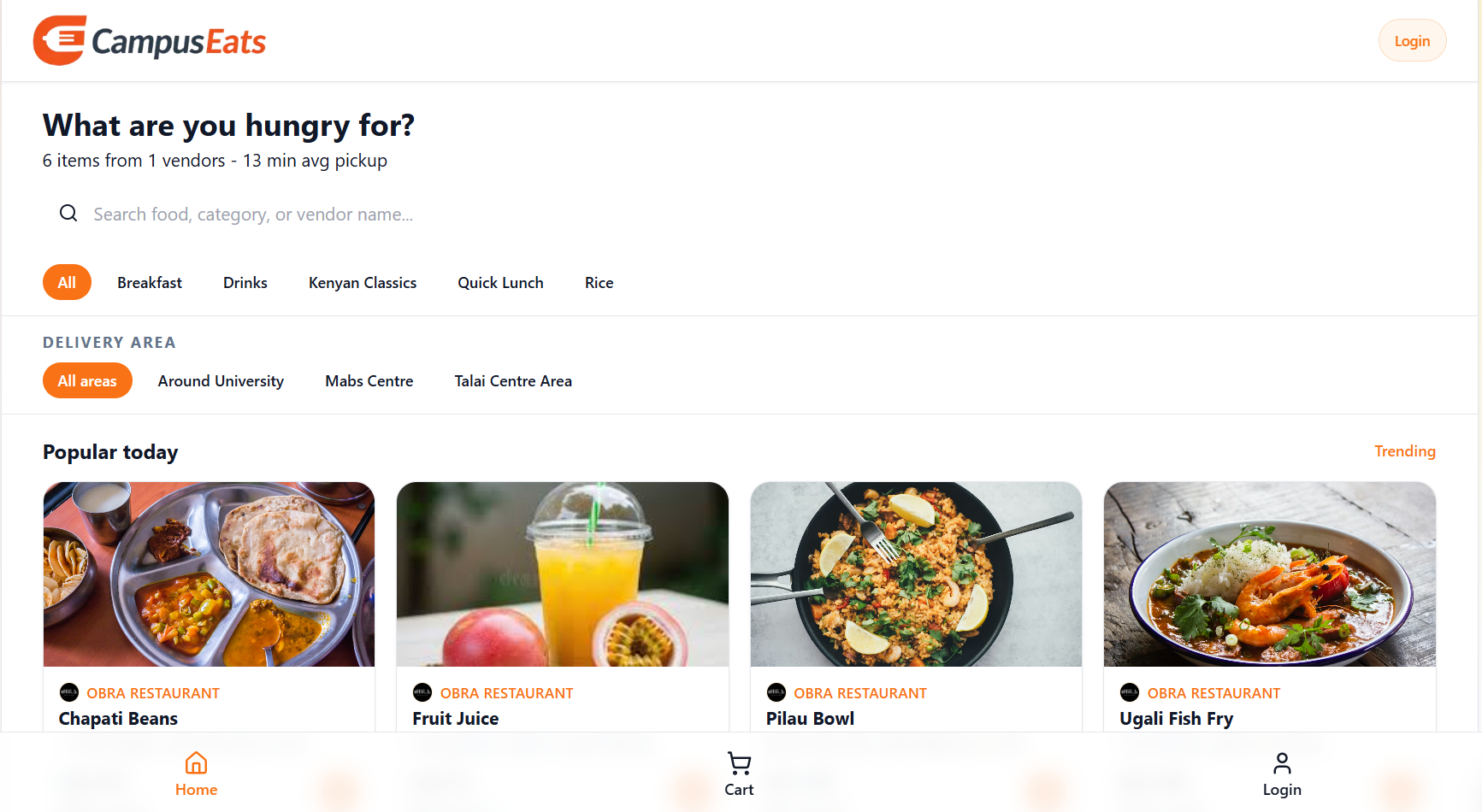
CampusEats is a campus food ordering and vendor management platform that connects students with nearby campus food vendors. Students can browse menus, place dine-in or delivery orders, and make secure payments online. Vendors manage menus, orders, delivery areas, and subscriptions through a dedicated dashboard, while administrators manage service areas, hostels, vendors, and platform operations.
The platform supports:
Dine-in and delivery ordering
Hostel and off-campus delivery handling
Vendor onboarding and store setup
Monthly vendor subscription model
Secure online payments with IntaSend
Real-time order management
Admin-controlled service areas and hostels
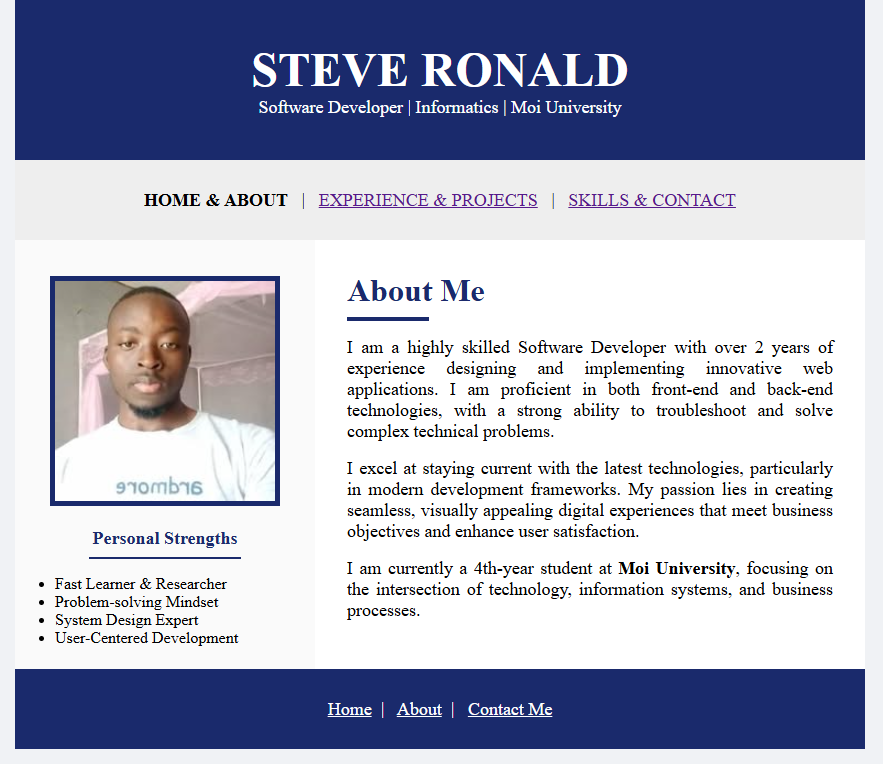
This portfolio represents the beginning of my design journey. It features projects I created while learning and experimenting with design principles. While simple, it laid the foundation for my current skills and reflects my progress and continuous improvement as a designer.
EcoNest: A Full-Stack E-commerce Platform for Sustainable Living
Project Overview
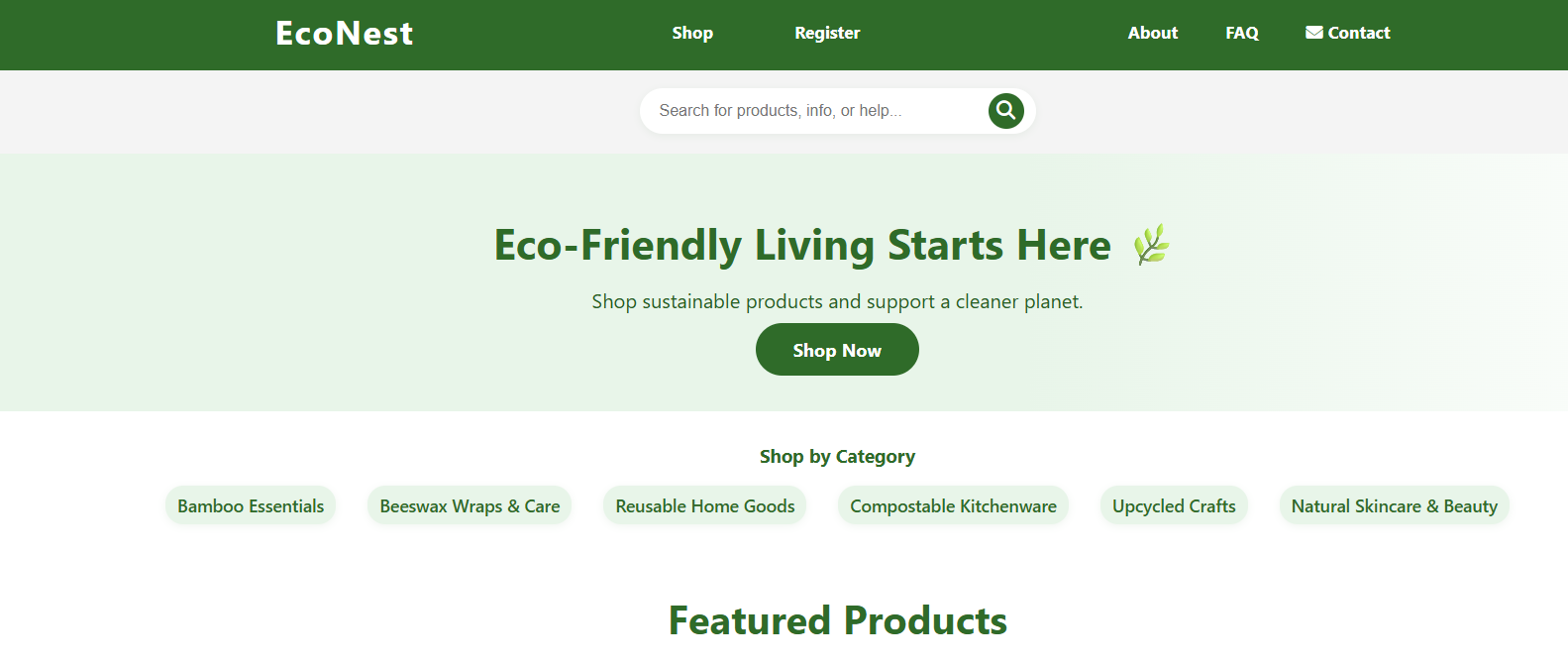
EcoNest is a full-stack e-commerce web application built to tackle the pressing challenge of household waste. The platform serves as a centralized marketplace for eco-friendly, sustainable alternatives to everyday products. My goal was to move beyond the concept of mere consumption and create a digital space that empowers users to easily discover, evaluate, and purchase items that actively reduce their environmental footprint, replacing single-use plastics and non-sustainable goods.
From a technical standpoint, the project focuses on scalability, performance, and a frictionless user experience. It implements a structured product catalog, secure user authentication, and an optimized shopping flow designed to make sustainable choices the easy choice. The system is architected to support future expansion, including inventory management, sales analytics, and third‑party integrations, positioning EcoNest as a flexible foundation for sustainable e‑commerce solutions.
The Problem: The Hidden Cost of Consumption
"Imagine the number of products we consume in a single day. After we use them, what happens to the remaining residue, the polythenes, the cans, the packaging?"
This question was the catalyst for EcoNest. Our modern lifestyle generates an immense amount of waste, leading to environmental pollution and resource depletion. While awareness is growing, finding reliable, attractive, and affordable eco-friendly alternatives often requires significant effort. Products are scattered across different vendors, their environmental claims are hard to verify, and the purchasing process can be cumbersome. This friction discourages adoption, allowing the cycle of waste to continue.
The Solution: A Centralized Hub for Eco-Conscious Choices
EcoNest directly addresses these pain points by providing a dedicated, user-friendly platform where sustainability is the standard, not an exception.
1. Curated Discovery: Instead of searching through endless irrelevant items, users can browse a structured catalog of vetted, eco-friendly products. Categories range from reusable kitchenware and biodegradable cleaning supplies to sustainable personal care items.
2. Informed Decisions: Each product page provides detailed information about its sustainable materials, usage, and environmental benefits, helping users make informed choices.
3. Frictionless Adoption: The core of the platform is an optimized shopping flow. By reducing the steps and effort required to find and purchase green products, EcoNest lowers the barrier to adopting a more sustainable lifestyle.
4. Built for the Future: The architecture supports easy expansion, meaning the platform can grow to include features like vendor dashboards, detailed impact tracking, and community features, further promoting the ecosystem of sustainability.
Technology Stack
This project was built using a focused and robust stack to ensure a solid foundation.
1. Backend: PHP
2. Frontend: HTML, CSS, JavaScript
Key Features & Technical Implementation
1. Structured Product Catalog: Implemented a dynamic product listing with categories, search, and filter functionality, allowing users to efficiently navigate the growing inventory of sustainable goods.
2. Secure User Authentication: Developed a complete user registration and login system with password hashing and session management to protect user data and enable personalized features.
3. Optimized Shopping Cart & Checkout: Engineered a streamlined shopping cart and checkout process to minimize friction, a key factor in converting interest into a sustainable purchase. The focus was on a clear and intuitive flow from product selection to order placement.
4. Modular & Scalable Architecture: The codebase is organized to separate concerns (e.g., presentation, business logic, data access), making the project maintainable and ready for future enhancements like inventory management, sales analytics dashboards, or third‑party logistics integrations.
Future Enhancements
EcoNest is designed as a foundational platform. Planned future developments include:
1. Advanced Analytics: Implementing dashboards to provide insights into sales trends, popular sustainable categories, and user behavior.
2. Vendor/Inventory Management: Creating dedicated portals for vendors to manage their own product listings and stock levels.
3. Sustainability Tracking: Adding features to calculate and display the positive environmental impact of a user's purchases (e.g., "You've saved X plastic bottles!").
4. Community Features: Allowing users to review products and share their own sustainable living tips.
What I Learned & Key Takeaways
Building EcoNest was a deeply rewarding experience that blended a strong technical challenge with a meaningful purpose. I reinforced my skills in full‑stack development, particularly in creating seamless user experiences with PHP and JavaScript. More importantly, I learned how to architect a project with both immediate usability and long‑term scalability in mind. The biggest takeaway was understanding how thoughtful software design can directly contribute to solving real-world environmental problems by making sustainable actions more accessible to everyone.
Global Tech Salary Insights 2025: An Analytics Dashboard for Career Planning
Project Overview
Global Tech Salary Insights 2025 is a data analytics project designed to bring clarity to the often confusing and scattered information about technology industry salaries. In a rapidly evolving job market, students, career changers, and even experienced professionals struggle to find reliable, consolidated data on what different roles pay and where the best opportunities are located. This project addresses that gap by analyzing salary trends across the global tech industry.
The primary goal was to create a centralized "salary insights workbook" that identifies the highest-paying jobs projected for 2025, pinpoints the countries offering the best compensation, and explores the potential factors driving those trends. By standardizing all salary data into Euros (EUR) and presenting it through a visual and easy-to-read format, the project empowers individuals to make informed, data-driven career decisions rather than relying on guesswork.
The Problem: Scattered Information & Opaque Career Decisions
For anyone navigating the tech industry, understanding your market value is a critical yet difficult task. Salary information is often:
1. Scattered: Found across disparate job boards, forums, and outdated surveys.
2. Inconsistent: Reported in different currencies and formats without standardization.
3. Lacking Context: Raw numbers without insights into role seniority, company type, or geographic cost of living.
This lack of clear, consolidated information makes it challenging to answer fundamental career questions like: "Which tech role should I specialize in for the best financial future?" and "Where in the world can I earn the most for my skills?"
The Solution: A Data-Driven Salary Compass
This project tackles these challenges by consolidating and analyzing salary data to provide actionable insights.
1. Centralized Insights: It brings together salary information into a single, coherent "workbook," eliminating the need to search through multiple sources.
2. Global & Role-Specific Analysis: The analysis goes beyond simple averages to identify the highest-paying roles for 2025 and the countries leading in compensation for those roles.
3. Contextual Understanding: It explores the why behind the numbers, investigating potential factors such as local demand for specific skills, cost of living, and industry hubs that contribute to higher pay in certain regions.
4. Actionable Career Guidance: The ultimate output is a tool that helps individuals identify the best career path for themselves and where to seek employment based on their salary goals.
Methodology & Approach
1. Data Collection & Standardization: Salary data for various tech roles was gathered from reliable sources. A key step was standardizing all compensation figures into Euros (EUR) to enable accurate, currency-agnostic comparisons across different countries.
2. Exploratory Data Analysis (EDA): The cleaned data was analyzed to identify key metrics, including:
Average salary by job title.
Salary distribution (range, common values) for each role.
Top-paying countries for the tech industry as a whole and for specific roles.
3. Factor Analysis: I investigated potential correlations between high salaries and external factors like the presence of major tech hubs, local economic conditions, and demand/supply dynamics for specific skill sets.
4. Visualization & Dashboard Creation: The insights were transformed into an intuitive, visual format. The goal was to create a "salary insights workbook" that is not just a report, but a tool for exploration, allowing users to easily compare roles and locations at a glance.
Key Insights & Findings
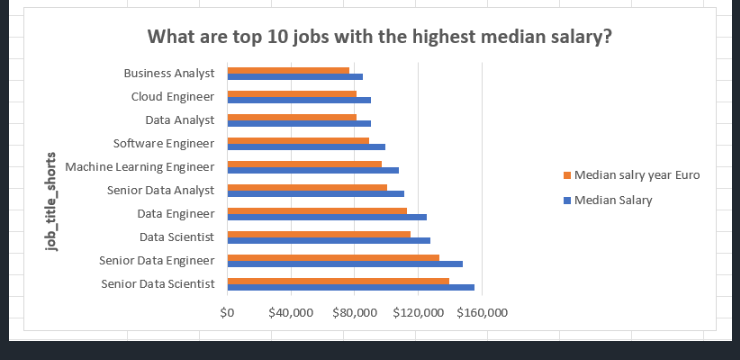
1. Top-Paying Roles for 2025: The analysis identified a clear hierarchy of the highest-paying jobs in the tech industry for the projected year, highlighting roles that command a premium in the global market.
2. Geographic Pay Hubs: The project pinpointed specific countries and regions that offer the highest compensation packages, revealing significant geographic disparities in tech salaries.
3. Drivers of High Pay: The investigation into contributing factors shed light on why certain locations pay more. This includes the concentration of high-revenue tech companies, a competitive talent market for niche skills, and adjustments for local economic conditions.
4. Salary Benchmarks: For each major role (e.g., Data Scientist, Software Engineer, Cloud Architect), the workbook provides a clear picture of typical salaries and their common ranges, serving as a powerful benchmark for job seekers and professionals.
Target Audience & Impact
This project is designed for three primary groups:
1. Students & Career Changers: To identify which tech roles offer the best financial prospects and align with their interests.
2. Current Tech Professionals: To benchmark their own compensation against global standards and identify potential career moves for higher earning potential.
3. Job Seekers: To understand which countries are offering the most competitive salaries for their specific skill set, guiding their international job search.
Future Enhancements
To make this tool even more powerful, future iterations could include:
1. Experience Level Filtering: Adding granularity by breaking down salaries by entry-level, mid-level, and senior positions.
2. Skills-Based Analysis: Correlating specific technical skills (e.g., Python, AWS, AI/ML) with salary premiums.
3. Cost of Living Adjustment (COLA): Integrating cost-of-living data to provide a clearer picture of "real" purchasing power in different countries.
4. Interactive Dashboard: Developing a fully interactive web-based dashboard where users can filter and explore the data themselves in real-time.
What I Learned
This project was a powerful exercise in transforming raw data into a strategic tool for decision-making. I honed my skills in data cleaning, standardization (especially with currency conversion), and exploratory analysis to extract meaningful trends. The most valuable takeaway was learning how to frame a technical analysis around a specific user's needs in this case, providing clarity and actionable guidance for career planning. It reinforced my belief that data is most powerful when it is used to empower individuals to make better-informed decisions about their own futures.
Kukusoko: AI-Powered Marketplace for Poultry Farmers
Project Overview
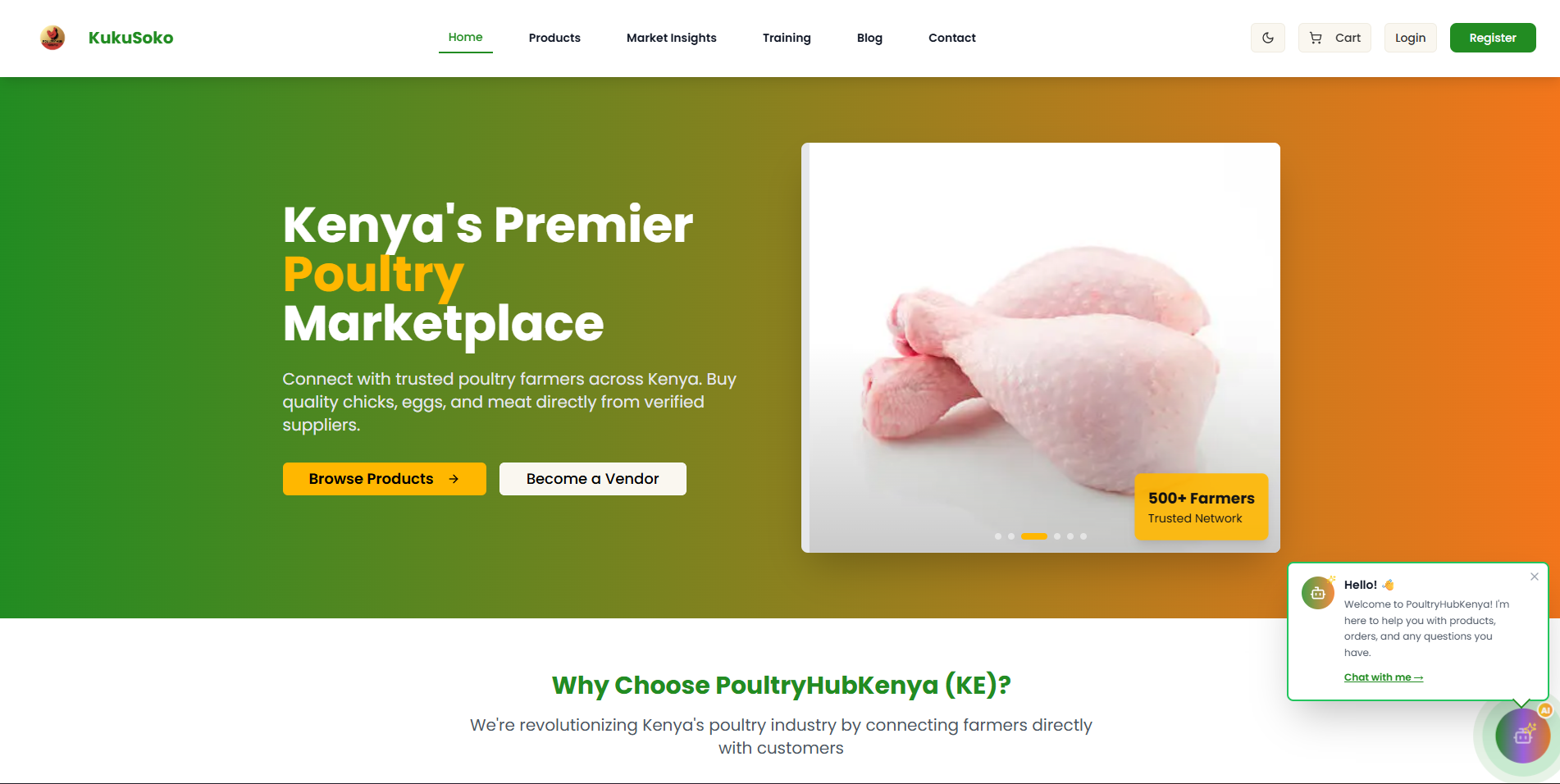
Kukusoko is an innovative, AI-driven poultry solutions platform designed to bridge the critical gap between smallholder poultry farmers and their potential customers. While countless families depend on poultry products like eggs and chicken for their daily nutrition, the farmers who produce these high-quality goods often struggle to find reliable, broad-reaching markets. Kukusoko directly addresses this market inefficiency by providing a dedicated platform that simplifies how farmers list, manage, and sell their poultry-related products.
The core innovation of Kukusoko lies in its sophisticated use of artificial intelligence, specifically the Gemini API to automate and validate product listings. The system leverages Gemini's multimodal capabilities to analyze uploaded images, verify they are poultry-related through intelligent keyword detection, and generate accurate, ready-to-use product descriptions. This powerful combination reduces manual work for farmers, improves the quality and consistency of listings, and helps vendors get their products online faster. The platform also features a Chatbase-powered AI chatbot to assist users in real-time. Built with scalability in mind using a modern tech stack, Kukusoko focuses on accessibility, efficiency, and trust, creating a thriving digital ecosystem for the poultry industry.
The Problem: The Hidden Struggle of Smallholder Farmers
"Imagine the number of families that depend on poultry products like eggs and chicken. On the other side, there are smallholder poultry farmers who produce high-quality products but lack access to the market."
This disconnect is the heart of the problem. These dedicated farmers are often limited to selling within their immediate locality, relying on personal connections, word-of-mouth, or fragmented platforms like Facebook Marketplace and WhatsApp groups. But the critical question is: do these general-purpose platforms truly have what farmers and customers need? The answer is no.
For Farmers: These platforms offer no specialized tools for inventory management, no verification to build customer trust, and their listings get lost in a sea of unrelated content. The process is inefficient, time-consuming, and fails to reach a wider, dedicated customer base.
For Customers: Finding reliable, local sources for fresh poultry products is a challenge. They cannot easily verify the quality or trust the sellers on unmoderated platforms.
The result is a fractured market where quality products struggle to find willing buyers, and customers struggle to find quality sellers.
The Solution: A Dedicated, AI-Enhanced Poultry Marketplace
Kukusoko is built from the ground up to solve these specific challenges. It is not just another marketplace; it is a comprehensive solution tailored to the unique needs of the poultry value chain.
AI-Powered Listing Automation with Gemini API: We leverage Google's Gemini API to eliminate the two biggest hurdles in creating a product listing:
Intelligent Image Analysis & Verification: When a farmer uploads an image, the Gemini API analyzes its content. The system then checks the API's response for poultry-related keywords (e.g., "chicken," "egg," "rooster," "hen," "poultry feed"). If the image is irrelevant, the listing is rejected maintaining platform focus and preventing spam.
Automated Description Generation: Based on the verified image and the product name/category provided by the farmer, Gemini generates accurate, compelling, and ready-to-use product descriptions. This saves farmers immense time and ensures all listings have a professional, consistent quality.
Real-Time User Assistance with Chatbase: An intelligent chatbot powered by Chatbase is integrated throughout the platform. It provides instant support to farmers and buyers, answering questions about listing products, navigating the marketplace, or placing orders.
Dedicated Poultry Marketplace: Unlike Facebook or WhatsApp, Kukusoko is a purpose-built platform where buyers know they will find only poultry products. This focused environment builds trust and makes the search process efficient for both parties.
Scalable & Modern Architecture: Built with a robust, modern stack to support future growth and a seamless user experience.
Technology Stack
Kukusoko is built on a modern, scalable architecture designed for performance and real-time interaction.
Artificial Intelligence:
Google Gemini API: Powers the core AI features by analyzing image content for verification and generating intelligent product descriptions.
Chatbase: Provides the conversational AI backend for the platform's chatbot, offering instant, 24/7 user support.
Backend:
PHP: Handles core application logic, user authentication, and traditional server-side rendering where appropriate.
Node.js with WebSockets: Manages real-time features, specifically the live chat functionality between buyers and sellers, enabling instant communication.
Database: MySQL (via XAMPP environment for development) for robust, relational data storage of users, products, orders, and messages.
Frontend:
React: Builds a dynamic, component-based user interface for a smooth and responsive single-page application experience.
Tailwind CSS: Enables rapid, custom UI development with a utility-first approach, ensuring a clean and consistent design.
CSS: For any additional custom styling and fine-tuned design elements.
Key Features & Technical Implementation
Gemini-Powered Image Verification: Implemented a custom verification layer using the Gemini API. The system sends uploaded images to Gemini, parses the textual response, and uses keyword matching to automatically accept or reject listings, ensuring only poultry-related content appears on the platform.
AI-Generated Product Descriptions: Leveraged Gemini's natural language generation capabilities to create detailed, accurate product descriptions. This feature significantly reduces the time and effort required for farmers to list new products and maintains a high standard across all listings.
Real-Time Chat with WebSockets: Built a dedicated chat system using Node.js and WebSockets, allowing buyers and sellers to communicate instantly about products, pricing, and pickup/delivery details, fostering trust and closing sales faster.
Chatbase AI Assistant: Integrated the Chatbase chatbot widget to handle common user queries, guide new users through the platform, and provide instant support, reducing the need for human customer service.
Comprehensive Database Schema: Designed a robust MySQL database to manage complex relationships between users, product listings (with AI-generated fields), orders, and chat messages.
Responsive React Frontend: Developed a dynamic and fully responsive user interface with React and Tailwind CSS, ensuring a seamless experience whether a farmer is listing products from a smartphone or a buyer is browsing from a desktop.
Impact & Value Proposition
Kukusoko creates value for every stakeholder in the poultry ecosystem:
For Smallholder Farmers: Gains access to a wider, more relevant market. Reduces the time and technical skill needed to create professional online listings through AI automation. Builds a trusted online presence and can communicate directly with buyers via real-time chat.
For Customers: Provides a single, trusted destination to find fresh, high-quality poultry products directly from local farmers. Simplifies the search and purchasing process with an AI assistant for help and real-time chat for negotiations.
For the Poultry Industry: Formalizes and strengthens the digital marketplace, fostering growth, efficiency, and trust across the entire value chain.
Future Enhancements
Kukusoko is a platform with immense potential for growth. Future plans include:
Logistics & Delivery Integration: Partnering with or building a logistics network to handle the delivery of live birds and perishable products.
Bulk Ordering & B2B Tools: Creating features for restaurants, hotels, and other businesses to place bulk orders easily.
Farmer Financial Services: Integrating options for micro-loans or savings programs to help farmers invest in their production.
Predictive Analytics: Using sales data and AI to help farmers anticipate demand and plan their production cycles more effectively.
Advanced Image Recognition: Training a custom model to not just verify but also classify poultry breeds or detect signs of disease from farmer-uploaded images.
What I Learned
Building Kukusoko was a profound lesson in applying cutting-edge AI to solve a deeply human and economic problem. Integrating the Gemini API taught me how to leverage multimodal models for practical, real-world validation and content creation. Combining this with a Node.js WebSocket server for real-time chat and a React frontend gave me invaluable experience in building a full-stack application with diverse, modern technologies. The greatest takeaway was understanding that technology's most powerful role is to remove friction and empower people. By automating tedious tasks with AI and enabling instant communication, we are enabling farmers to focus on their core business, and in doing so, we are helping to build a more efficient and trustworthy food system for everyone.
CodeCraft Academy: Democratizing Tech Education for the Next Generation
Project Overview
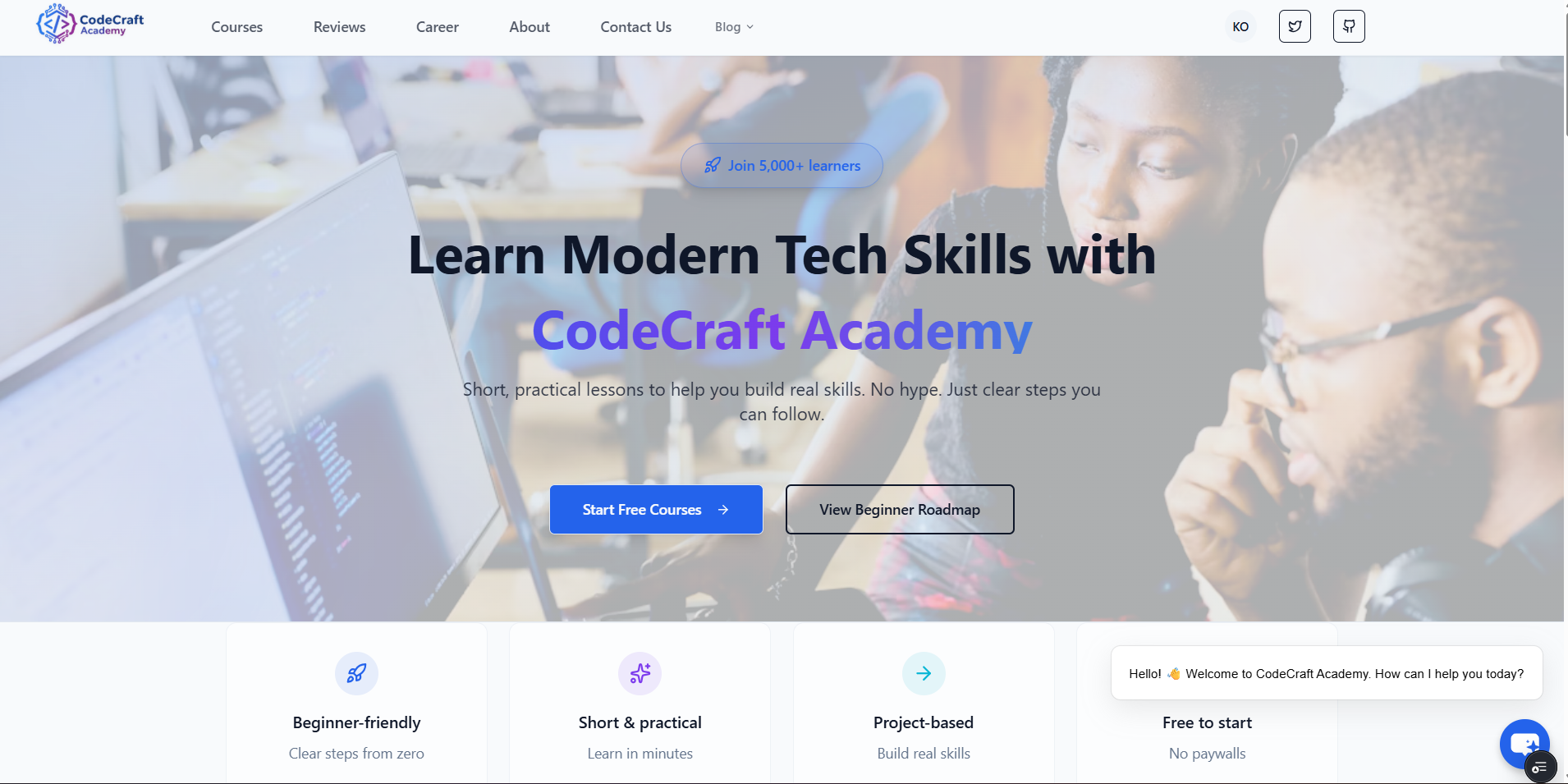
CodeCraft Academy is an educational technology platform built with a single, powerful mission: to make tech education accessible, structured, and affordable for everyone. In a world increasingly driven by technology, the platform provides beginner-friendly courses, practical tutorials, and real-world learning resources designed specifically for aspiring developers who lack access to traditional educational pathways.
The inspiration behind CodeCraft Academy is deeply personal and rooted in the reality of educational inequality. Every year, hundreds of thousands of students complete their secondary education with dreams and potential, yet only a small fraction can afford university or vocational training. CodeCraft Academy was created to bridge this gap, offering high-quality IT-related courses at affordable prices, with many resources available completely free of cost. The goal is simple: ensure that passion for technology, not financial privilege, determines who gets to participate in the digital economy.
Built on a modern, scalable stack including Next.js, Supabase, and React, and deployed on Vercel, the platform is designed for performance, accessibility, and growth ready to serve learners across the country and beyond.
The Problem: The Educational Opportunity Gap
"Just imagine: when we did our KCSE, we were around 1,000,000 students who sat for the same exam. But what percentage joined universities, colleges, or training institutions? A few. What about the rest? What about those who lacked school fees even after passing with a grade that would have secured them a place in campus? What about those who may not have attained the required grade but would still love to join tech?"
These questions are the foundation upon which CodeCraft Academy is built. The reality is that every year, hundreds of thousands of young people with potential, ambition, and passion are locked out of educational opportunities not because they lack ability, but because they lack resources.
The consequences extend far beyond individual disappointment. In an era where nearly every industry is being transformed by technology, we are collectively losing the contributions of countless innovators, problem-solvers, and creators simply because the path to tech education is gated by financial barriers.
Traditional institutions, while valuable, remain inaccessible to many due to:
High tuition costs that exclude talented students from low-income backgrounds.
Geographic limitations that require relocation to urban centers.
Rigid admission requirements that don't account for alternative pathways or late-blooming potential.
Outdated curricula that struggle to keep pace with the rapidly evolving tech industry.
The Solution: Accessible, Quality Tech Education for All
CodeCraft Academy was created to tear down these barriers. It is not just another online learning platform, it is a social mission brought to life through technology.
Affordable & Free Learning: The platform offers IT-related courses at prices designed to be accessible to students from all economic backgrounds. Crucially, many resources and foundational courses are available completely free of cost, ensuring that financial constraints are never the reason a passionate learner is turned away.
Beginner-First Approach: Every course is designed with absolute beginners in mind. Complex concepts are broken down into digestible modules, with practical tutorials that help students build real projects from day one.
Structured Learning Pathways: Unlike the scattered tutorials found on YouTube or free blogs, CodeCraft Academy provides structured, curriculum-based learning paths that guide students from zero knowledge to job-ready skills.
Real-World Focus: The platform emphasizes practical, project-based learning. Students don't just learn syntax, they build applications, solve problems, and create portfolios that demonstrate their abilities to future employers.
Accessible Anywhere: As a web-based platform, CodeCraft Academy is accessible to anyone with an internet connection—whether they're in a major city or a remote village.
Technology Stack
CodeCraft Academy is built on a modern, cutting-edge stack designed for performance, scalability, and developer productivity.
Framework: Next.js Provides server-side rendering, static site generation, and optimized performance out of the box, ensuring fast page loads and excellent SEO for course discovery.
Frontend: React Powers the interactive user interface, creating a smooth, dynamic learning experience.
Backend & Database: Supabase Serves as the complete backend solution, providing:
PostgreSQL Database: Robust, relational data storage for users, courses, lessons, and progress tracking.
Authentication: Built-in user authentication for secure signup, login, and profile management.
Real-time Capabilities: Enables features like live progress tracking and community interactions.
Storage: Manages course materials, videos, and learning resources.
Deployment: Vercel Provides seamless deployment, automatic SSL, and global CDN distribution, ensuring the platform is fast and reliable for users everywhere.
Key Features & Technical Implementation
1. Course Catalog & Management System: Built a comprehensive course listing system with Supabase PostgreSQL, allowing easy organization of courses by category, difficulty level, and price (free vs. paid). Each course has dedicated pages with curriculum overviews, learning objectives, and enrollment options.
2. User Authentication & Profiles: Implemented Supabase authentication to create secure user accounts. Each learner gets a personalized profile tracking their enrolled courses, completed lessons, and learning progress.
3. Interactive Learning Interface: Designed a clean, distraction-free lesson viewing experience using React components. Lessons combine text, video embeds, code snippets, and practical exercises to cater to different learning styles.
4. Progress Tracking: Developed a system to track user progress through courses, marking lessons as complete and visualizing advancement through intuitive progress bars and checkpoints.
5. Responsive Design: Leveraged Next.js and React to create a fully responsive interface that works seamlessly on desktop, tablet, and mobile devices essential for learners who may only have access to smartphones.
6. SEO Optimization: Utilized Next.js server-side rendering capabilities to ensure course pages are properly indexed by search engines, helping students discover the platform organically.
7. Vercel Deployment Pipeline: Set up continuous deployment with Vercel, ensuring that updates and improvements reach users instantly with zero downtime.
Impact & Social Mission
CodeCraft Academy exists to answer a fundamental question: What happens to the dreams of students who cannot afford traditional education?
The platform's impact is measured not just in lines of code, but in lives transformed:
1. For the Student Who Passed with a Grade but Lacked Fees: CodeCraft Academy offers an alternative pathway to gain valuable, employable skills without the burden of university tuition.
2. For the Student Who Didn't Attain the Required Grade: The platform provides a second chance. Passion and determination, not exam scores, become the entry requirements.
3. For Anyone with Passion but No Privilege: CodeCraft Academy levels the playing field, ensuring that anyone with internet access and the will to learn can participate in the technology-driven economy.
4. For the Industry: By democratizing access to tech education, we help create a larger, more diverse talent pool enriching the entire technology ecosystem with perspectives and problem-solvers who might otherwise have been lost.
Future Enhancements
CodeCraft Academy is built for growth. Future plans include:
1. Community Features: Adding discussion forums, study groups, and peer mentoring to foster collaborative learning.
2. Project Showcases: Creating a space where students can share their projects, receive feedback, and build portfolios.
3. Certificate of Completion: Issuing verifiable certificates for completed courses to help students demonstrate their skills to employers.
4. Mobile Application: Developing a dedicated mobile app for offline learning and an even more accessible experience.
5. Job Placement Partnerships: Connecting top-performing students with internship and entry-level job opportunities at partner companies.
6. Localized Content: Expanding course offerings in local languages to reach even more learners in underserved communities.
What I Learned
Building CodeCraft Academy was the most personally meaningful project I have undertaken. It taught me that technology is most powerful when it serves a human purpose when it opens doors, breaks down barriers, and creates opportunities for those who need them most.
From a technical perspective, working with Next.js and Supabase gave me deep appreciation for modern full-stack development. I learned how to leverage server-side rendering for performance and SEO, how to design efficient database schemas in PostgreSQL, and how to create seamless authentication flows. Deploying on Vercel taught me the value of a streamlined CI/CD pipeline and global content delivery.
But the most important lesson was this: the best technology projects solve real problems for real people. CodeCraft Academy is not just a demonstration of technical skill, it is a response to a problem I have witnessed, a small contribution toward a more equitable future. It has reinforced my belief that as developers, we have both the privilege and the responsibility to build things that matter.